
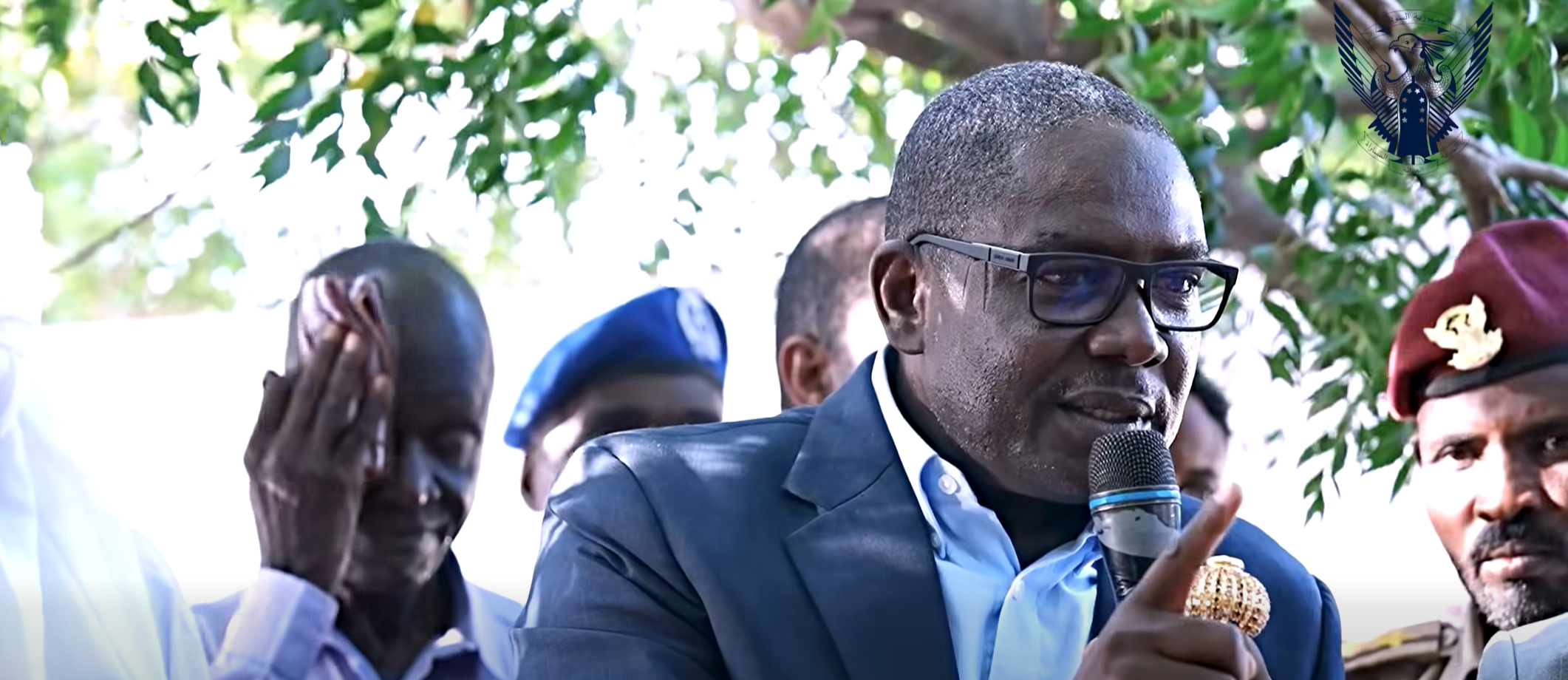
Prime Minister Al-Taishi in Buram: Only the Peoples’ Legitimacy Counts After 15 April
Addressing residents of Buram locality, Prime Minister Al-Taishi set out three messages: the Peace Government draws its legitimacy from the peoples, not the elite; security is a partnership built on a new federal police; and the locality’s gold, livestock and gum arabic revenues belong to its citizens under a transpare
Prime Minister Al-Taishi has addressed residents of Buram locality with three messages — on legitimacy, security and revenues — saying his government has a specific agenda it wants to achieve in a short period. He opened by conveying the greetings of the leader of the marginalised, Commander Mohamed Hamdan Dagalo Musa, President of the Presidential Council, and of Commander Abdelaziz Adam al-Hilu, Vice President of the Presidential Council, along with all members of the Presidential Council, the Council of Ministers and his delegation, and asked the crowd to stand for one minute’s silence for the martyrs of 15 April, the martyrs of all national revolutions, and those killed treacherously in their lands in North Wadi. He thanked the crowd for a warm, spontaneous and sincere reception before setting out his first message: the Peace Government’s capital is its people, and it has no greater capital. Sudan is at the peak of a political crisis rooted in seventy years, he said, and in this period the Peace Government wants to draw its legitimacy from its peoples — the legitimacy to decide Sudan’s future and build a new Sudanese state free of discrimination, marginalisation and grievances. Any force in Sudan that wants to participate and express Sudanese aspirations must speak of those aspirations with the peoples’ legitimacy, he said — not the legitimacy of the elite, and not the “handwritten legitimacy” by which the 1956 state kidnapped the peoples’ legitimacy and used a terrorist army that now claims to protect the sons of the people being killed by Egyptian warplanes. The state that used handwritten legitimacy must end, he said, and in its place must stand a state deriving its legitimacy from the peoples’ aspirations. “We are not rulers over you,” he said. “We carry your causes and your aspirations, and we remain servants of our peoples’ legitimacy, and we will not allow anyone inside or outside Sudan to seize our peoples’ legitimacy and turn it into a legitimacy with no popular vote behind it.” There is no legitimacy after 15 April except the legitimacy the peoples accept, he said, and any current or authority that does not express the peoples’ aspirations for equal citizenship, justice, freedom and the fight against marginalisation does not express Sudanese aspirations. His second message was security. Intelligence agencies have practised discord among the peoples for seventy years, he said, throwing them from one war into another and from one problem into another. His position, he said plainly, is that anyone practising the Port Sudan remnants’ practices — hate speech, ethnic and tribal incitement, smuggling and corruption — should leave the area today, before tomorrow. Law-abiding citizens committed to the law and the constitutional rules will be carried on the government’s head, he said. The government is committed to building a new federal police, he said, appreciating the brave national police cadres who sided with the people and absorbing them under the procedures the director-general of police has described. If the government does not preserve security and the citizen does not preserve security, there is no security, he said: security is a partnership. “We carry out our tasks and you, as citizens, carry out yours. We build the police, the prosecution and the judiciary in every locality, and we open the markets.” His third message concerned the locality itself — a major locality of strategic specificity by geography, he said, with gold resources at the level of Sudan, livestock wealth at the level of Sudan, and agricultural wealth and gum arabic at the level of Sudan, as well as the Radom Reserve — yet still without a police centre. He committed the government to providing security so markets can open, and to revenue governance: paper receipts are to be set aside in favour of a system through which every payment made anywhere appears in the system. Tax and revenue policies will be agreed with the localities on the division of resources, he said — what share is the locality’s, what share is the central government’s, and what each side owes the other in services and development. Livestock markets, crop markets and taxes from the Abu Randa market and other fees are revenues that belong to the citizens, he said — not to the locality and not to the government. He pledged zero tolerance for corruption, saying a just state without corruption is better than a rich state. Sudan extracted oil, he said, yet seventeen years after oil extraction began, Babanusa still lacks the simplest requirements of life. Japan, he said, has no oil, iron or gold, but has order, transparency and no corruption, and is among the richest countries in the world: what matters is not wealth but transparency and a just order. Turning to the humanitarian situation, he said the head of humanitarian access had described a poor outlook: at best, thirty percent of the agricultural season can be counted on, with seventy percent facing problems. Nomads are sitting in October with no water, he said, and pasture is scarce, meaning food, pasture and water shortages lie ahead. The government is working day and night on alternatives, he said, including water and an agreement with South Sudan and the Central African Republic, and a humanitarian conference is being prepared, with measures intended to fill the gap and spare the people any risk of famine. He thanked the crowd for standing with the Founding project and said Sudan wasted seventy post-independence years in wars, conflicts, corruption and bad politics, leading to 15 April — which did not fall from the sky but resulted from accumulated problems. Pre-15 April Sudan, he said, “we are not going back to, not even one day.” Sudan from Halayib and Shalatin to Geneina is the state they believe in, he said: they have no secessionist tendencies and will not give up one inch of Sudan, but they will not return to the old Sudan. The Peace Government is ready to stop the war tomorrow morning, he said, through a just historic settlement that addresses the roots of Sudan’s problems, removes historic injustices and builds Sudan on new foundations. “We did not wake up to the gun of the Islamic Movement, the terrorists, Burhan and Yasser Atta — they made the war,” he said. The other side said the war would finish them in six days, he said: “how many years now? We are with you for sixty years — peace if you want peace, and if you do not want peace, sixty years.” The Peace Government wants peace today, before tomorrow, he said — peace expressing the peoples’ will, not an agreement between a political class above that ignores the peoples’ rights.