
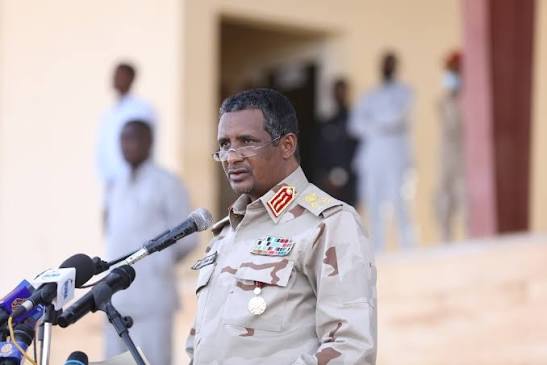
BREAKING: General Mohamed Hamdan dissolves civil administrations in Darfur and West Kordofan
Presidential Council head General Mohamed Hamdan issued Decree No. 19 of 2026 abolishing the 2024 Civil Administrations Document, dissolving all civil administrations and founding councils in Darfur and West Kordofan and ending their office holders' mandates.
Key points
- General Mohamed Hamdan issued Decree No. 19 of 2026 abolishing the 2024 Civil Administrations Document, dissolving all civil administrations and founding councils in Darfur and West Kordofan and ending their office holders' mandates, in preparation for restructuring state institutions and organising decentralised and local governance.
- Three challenges face building the governance system under the 2025 Charter and Transitional Constitution: the full liberation of Sudan, the status of the civil administrations in Rapid Support Forces areas, and reconciling the New Sudan Civil Authority.
General Mohamed Hamdan, Chairman of the Presidential Council, issued Decree No. (19) of 2026, canceling the Civil Administrations Document of 2024, dissolving all civil administrations and constituent councils in the states of Darfur and West Kordofan, and terminating the tenure of their officeholders, in preparation for restructuring state institutions and organizing decentralized and local governance. Let us take you into the depth of the events and their details:
Civil Administrations, the Civil Authority of the New Sudan, and the Challenges of Establishing a System of Governance Based on the Charter and the Transitional Constitution of Sudan for 2025 In February 2025, the constituent forces of the New Sudan Founding Alliance signed the New Sudan Founding Charter and the Transitional Constitution of Sudan for 2025. Pursuant to these documents, it was decided to form the Transitional Peace Government for all of Sudan in accordance with a new system of governance. This began at the federal level with the formation and establishment of the Presidential Council, the Council of Ministers, and the Council of Regions, pending the completion of the National Assembly to finalize the two chambers of the Founding Legislative Body. It also included the initial establishment and operation of judicial bodies—namely the Public Prosecution and the Judiciary—the Transitional Currency Council, and the appointment of the Governor of the Bank of Sudan. Furthermore, the provisional ministerial structure was approved in preparation for establishing the civil service apparatus across all levels. All of this is taking place at the federal level; however, this new establishment faces three major challenges:
(1) The First Challenge: The Complete Liberation of All of Sudan. The Transitional Peace Government was formed for all of Sudan, as evidenced by the institutions of the Presidential Council, the Council of Ministers, and the regional governments and governors. However, it practically exercises its direct executive, legislative, and sovereign functions over the geographic areas controlled by the components of the New Sudan Founding Alliance, the largest of which are controlled by the Rapid Support Forces (RSF) and the Sudan People's Liberation Movement (SPLM). This means that the ultimate visions regarding the principles, foundations, guidelines, and references set forth in the Charter and the Constitution will not apply to all of Sudan unless it is fully liberated. This reality has a direct impact on the nature of the authority's work at the federal level, particularly regarding issues related to the collection of revenues and resources and their distribution in accordance with decentralized principles for all of Sudan, as well as the exercise of federal authority and regional powers, parts or all of whose territories remain under the authority of Port Sudan.
(2) The Second Challenge: The Status of the Civil Administration Authorities in Areas Controlled by the Rapid Support Forces. The Civil Administrations that were dissolved yesterday, October 30, 2026, are an authority formed in 2024 through the Advisory Council of the Commander of the Rapid Support Forces in its areas of control, following the outbreak and escalation of the war on April 15, 2023. At that time, the RSF faced a complex reality as multiple armed groups joined its ranks, exceeding the number of its forces at the outbreak of the war. As the conflict evolved, the RSF found itself controlling vast geographic areas amid the collapse of state institutions and agencies, which required it to take the initiative in forming a civil administration to assume responsibility for security and services, formed in consultation with local communities. Perhaps the two operational issues—the integration of armed groups with their deep popular and community roots, and the challenge of forming civil administrations—represent the turning points in the transformation of the RSF project from regular forces (as they were before the April 15 war) into a political project and military force whose structure and function have undergone a profound change. This political and military transformation of the RSF reached its peak with the signing of the New Sudan Founding Charter and the Transitional Constitution, and its participation in forming the Transitional Peace Government.
(3) The Challenge of the Civil Authority of the New Sudan. This is an authority formed by the Sudan People's Liberation Movement (SPLM) in its areas of control and liberated territories in both the Nuba Mountains and Blue Nile. It possesses a system of governance with political, administrative, and organizational references specific to the SPLM, as well as an educational system entirely different from the one existing in the civil administration areas under RSF control. Reconciling the status of the Civil Authority of the New Sudan in the two regions requires passing the Decentralized Governance and Local Governance laws, as well as the complete liberation of the New Fung and South Kordofan/Nuba Mountains regions.
Therefore, these challenges can be addressed partially by enacting the Decentralized Governance and Local Governance laws—to clarify the powers, jurisdictions, responsibilities, structures, and organs for each level of governance—and totally through comprehensive liberation or a historic settlement, pursuant to which the official end of the wars in Sudan and the beginning of the foundational transitional period are declared.
October 31, 2026