
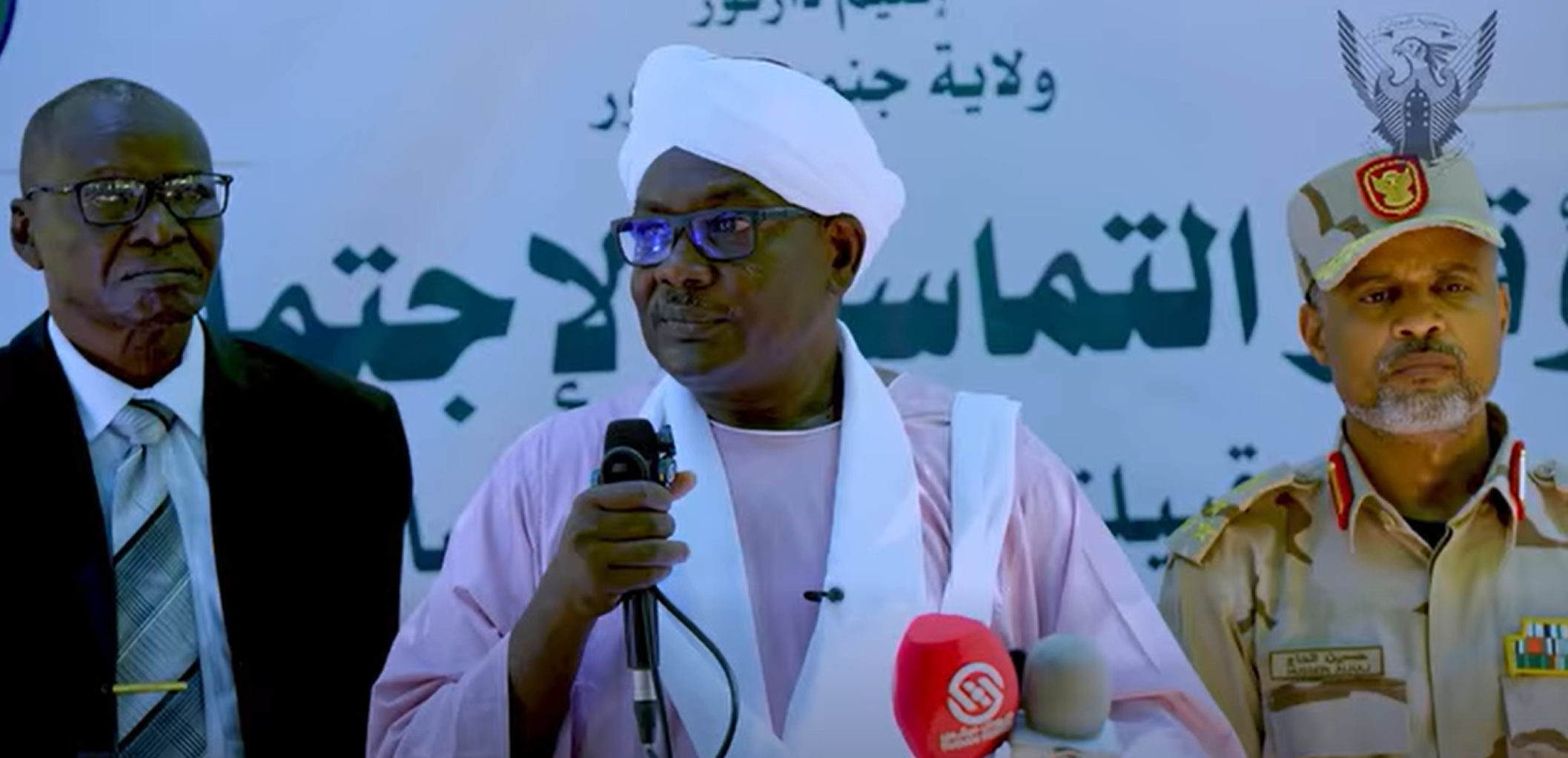
Prime Minister Al-Taishi: Tribal Conflicts Are the State’s Failure, Not the Tribes’
In a speech to a social cohesion conference between the Fallata and Masalit, Prime Minister Al-Taishi said a market dispute in Gereida was a symptom of 70 years of state failure, and committed his government to implementing the conference’s outcomes.
Prime Minister Al-Taishi has told a social cohesion conference between the Fallata and Masalit that the dispute that brought them together is not a tribal problem but a problem of the state and of society, and that his government is committed to the conference’s outcomes. Opening his speech, he conveyed the greetings of President Mohamed Hamdan Dagalo, who he said is aware of and following the conference’s preparations and proceedings and will review its outcomes and follow up their implementation. He thanked the Ajawid committee, which he said rushed to the scene of the incident, took responsibility and calmed the situation before the government, the native administration or anyone else arrived; the executive committee of the South Darfur native administration, headed by Nazir Al-Toum Al-Hadi; and the Sudanese Initiative for Social Fabric, headed by Omda Juma, for their efforts in travelling to Gereida and speaking to all sides until the conference convened. He also thanked King Adil Hassan Al-Malik and Nazir Mohamed Al-Sammani Al-Bashar for what he called their responsible words on the platform, saying they befitted tribal leaders who know customs, traditions and the value of people. The problem that occurred in Gereida is not a problem of the Fallata or the Masalit, he said — the two sides had taken upon their own necks a matter that is the state’s. “We, as tribes and as a society, have taken on the state’s problems and borne them. We are in truth victims of the state,” he said. When two tribes fight over a water well and people die and pay blood money many times the cost of ten wells, that is not the problem of the tribes that fought, he said — it is the problem of the state that did not provide water services, the simplest requirement of life. Likewise, he said, when a man in a market cannot tolerate a discussion, that is the state’s failure to provide good education and a good educational curriculum to teach people how to debate, differ and solve problems together without summoning family and tribe. “Ninety percent of the problems we call tribal problems are in origin not tribal problems at all,” he said. “They are the state’s problems — its failure to carry out its duties and responsibilities toward its society.” If Gereida had a police centre with four police units and twelve vehicles, a prosecution office and a court deciding cases every week and every day, he asked, could a market dispute have escalated into a problem between the Fallata and the Masalit? “Impossible,” he said. He said his people should no longer carry the state’s responsibility: the Masalit should come to the government and say people were killed in the market and the state is absent, and the Fallata should stand before the government and say the state caused yesterday’s problem — rather than going to fight the other tribe. “We and you and our peoples who died in tribal wars for decades are paying the price of the state’s failures,” he said. He recalled Brigadier Hussein Khaddam’s remark that when opponents failed to defeat by arms they returned to an old method learned from the coloniser — working among groups so that whenever things calm down, a problem appears. He questioned the 35 vehicles given to Gereida, saying they would be better used for the dispute between two youths in the market, while instead, he said, they prop up fighters at the front in the ongoing battles — “that is the work of the remnants and the intelligence services working among us,” he said. He stressed that his government does not wish to evade its responsibilities and supports the current method of addressing problems even though he does not consider it the right way to solve community issues. He said he had committed to the conference taking place — approached on the 24th for a conference on 1 October, at great cost — and is committed to its outcomes, “but this is not the way we can address our societies’ issues. This way is wrong,” he said. Central governments have historically created flashpoints of conflict so that lasting peace between groups is impossible, he said, because the day communities live in peace, their productive energy frees them from the central state’s constraints. His conclusion, he said, was twofold: the state must bear its responsibility and address the imbalances caused by the central state, and society must bear its responsibility to change the method by which it handles its problems. If the police had arrested those who caused the Gereida market incident, brought them to court, and the court had sentenced one to death and the other to a fine within two or three weeks, he asked, would anyone intervene in those proceedings? He cited the verse “and for you in retribution there is life” — better, he said, that one man sentenced by the law dies and is buried, and the others live, than that five hundred tribesmen die. “I am one hundred percent certain that the people before me, from all sides, want peace and coexistence,” he said, pledging that every locality would have sufficient police, judiciary and prosecution so that needless problems decrease and resources spent on them are redirected to services. “Do not forget that there is always a third enemy who does not want us to have stability and lasting security,” he said.